“I have always depended on the kindness of strangers.” — Blanche Dubois in “A Streetcar Named Desire”
Rave: Unlike Blanche, I’ve striven to never depend on the kindness of strangers. It seemes a very precarious way to live.
Still, there have been times when I’ve been blown away by the generous actions of those I don’t know.
This weekend was one of those times.
You see, while waiting to register at the Lori Foster Annual Reader and Author Get Together this weekend, I was chatting with the other women in line. In the course of that conversation, I mentioned that I’m always on the lookout for “gentle” (no sex, no violence, no offensive language) novels for some of my library patrons who prefer their romances a little less spicy. One of my fellow attendees suggested the book Spring Chickens might be a good choice. I made a note to look it up when I got home and thanked her for the suggestion.
But much to my astonishment, the same woman (whom I now know is Michelle Kelly) came up to me later that evening and handed me a copy of the book. She had purchased it for my library so I could share it with my patrons.
What an incredibly nice — and completely unexpected — gesture!
Clearly Michelle — whether she knows it or not — practices Ghandi’s philosphy of being the change you wish to see in the world. She saw a need and, without fanfare or glory, she filled it.
Wouldn’t it be nice if we all did the same?
And since I believe no good deed should go unrewarded, I hereby award Michelle this week’s “Big Prize” for generosity and thoughtfulness.
Last night in bed, sated after a day of picnicking and socializing on this holiday weekend, I thought about Memorial Day and what it’s supposed to mean.
Inevitably, my mind turned toward my father and the last time I truly commemorated Memorial Day by visiting his grave.
This led to my litany of those I will hold in my memory forever.
Some, like Dad, I loved or considered a friend.
My mother-in-law Viv
My friends Pat Carterette and Dale Hood
Others I knew only by association.
My co-worker’s son Jakob who died so recently and so young
The soldiers buried alongside my father at the Ohio Western Reserve National Cemetary, especially the one who died in a Blackhawk accident at the age of 23
I cry every time I read his gravestone.
Mary Rothgery, a Great Lakes Brewery employee who was shot by her husband after she filed for divorce, and all other victims of domestic abuse
I get tears in my eyes when I think of the Rothgery children too.
Some of the names on my list are from the distant past.
My grandparents, aunts, uncles and great-grandparents
Sandy and Mark, two friends who died in separate car accidents while I was in still in college
Whenever I think of Sandra, I remember her twin sister Sheila and wonder where and how she is.
My litany is an attempt to honor the memory of those who are gone, and as I grow longer, the list grows longer. Someday — when my litany is no more — I hope someone will pause and spare a similar thought for me.
And on Memorial Day, a holiday established to honor those who have died for our country, I say a prayer for those men and women too, as well as for those who continue to fight in the name of the United States.
Today, as I wrote this blog at 2:58 pm Memorial Day 2012, in a true case of serendipity, I came across the following:“The National Moment of Remembrance encourages all Americans to pause wherever they are at 3 p.m. local time on Memorial Day for a minute of silence to remember and honor those who have died in service to the nation. As Moment of Remembrance founder Carmella LaSpada states: ‘It’s a way we can all help put the memorial back in Memorial Day.’” (http://tinyurl.com/3gynq2f)
So I paused for a moment of remembrance. Perhaps when you read this, you will do the same even if it’s no longer the official time. It’s the thought that counts, right? Then maybe you’ll take another moment to repeat your own litany.
Finally, in one last tribute to those who have died in service to their countries, I offer the following poem, care of the inimitable Charles Schultz.
Pantser or plotter? Ask a writer this question, and she’ll have an immediate response.
“Oh, I’m a pantser,” she’ll say. “Can’t plot ahead to save my life.” Or “Definitely a plotter. I need to know where I’m going when I write.”
Ask a non-writer, and they’ll probably wander off muttering under their breath about people who ask rude questions.
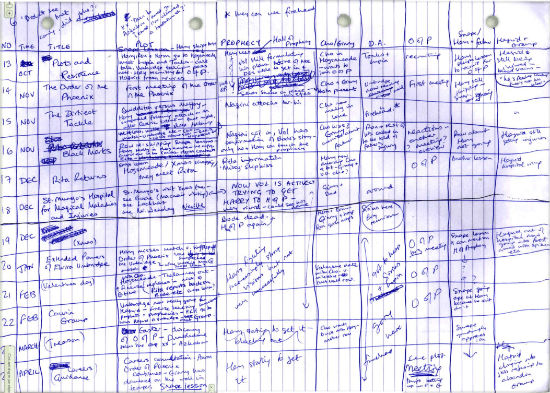
J.K. Rowling is a plotter. It’s said she outlined all of the Harry Potter novels before beginning the series. Several blogs including slashfilm.com have photos showing just how detailed Rowling’s charts could be (http://tinyurl.com/2eok9ox).
The one below is from Order of the Phoenix.
Now there’s a true plotter at work!
Stephen King and Nora Roberts are well-known (at least in writing circles) for writing “by the seat of their pants.” Brenda Novak is a pantser too. And I’ve heard several mystery writers say they can’t plot ahead because if they knew who the murderer was, they’d give it away.
I’m a plotting pantser — at times, “plodding pantser” might be more accurate — though I started as a true-blue pantser.
It was only after finishing one manuscript and starting another that I realized my stories were lacking something. My characters were fun, and they spoke in clever dialogue, but the books didn’t move!
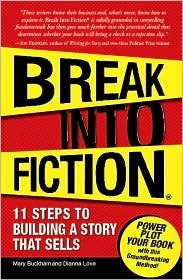
I turned to Mary Buckham and Dianna Love’s Break Into Fiction for help.
You see the little circle on the bottom of the cover that says “Power plot your book”? Well, after reading Love and Buckham’s advice, I understood my plot problem.
I didn’t have one.
Kind of an issue if I ever wanted to actually sell a book.
Which I did (and do).
Clearly, pantsing wasn’t working for me.
This should have come as no surprise because — much as I hate to admit it — spontaneity isn’t my strong point.
I’m an organizer — okay, a control freak — by nature.
My to-do list is updated and re-prioritized on a regular, often daily, basis.
And that annoying person who knows every detail about the family vacation destination — that’s me.
If we’re planning a party, I have a chore and cooking timetable laid out two weeks ahead. (My husband’s in charge of the beer, which generally involves a lot of “tasting” at Great Lakes [http://tinyurl.com/c249cc3] Yeah, it’s an unfair world :-)).
I don’t even drive to Columbus — an hour and a half away — without both a Mapquest printout and my GPS. So what the hell was I thinking, attempting to write a book without some sort of outline?
I needed a plan! Or a plot, which in this case was sort of the same thing.
Fortunately, a writer can learn how to plot, and I’ve since attended several good workshops and workshop sessions on the topic. After hearing my friend Donna MacMeans (http://www.donnamacmeans.com/) explain plotting with what she calls the “W plot,” I began to understand the concept. (Here’s a link to Kathleen Wall’s excellent blog posting on Donna’s presentation: http://tinyurl.com/6q296bq).
More recently, I heard Alexandra Sokoloff speak about using screenwriting techniques to craft a good novel. (She’s also written a book on the subject, available on her website [http://alexandrasokoloff.com/]).
I like Sokoloff’s approach because it includes making lists(!) of favorite movies and books, and breaking them down by plot element. By understanding these components, I can learn to include them in my own writing.
This could work.
I already know that starting a book without at least a basic outline of the story doesn’t work for me. I need a good idea of where the story is going, how I’ll keep the problematic middle from sagging and at least some concept of the ending.
The rest I can make up as I go along, allowing allows characters to take on a life of their own and new ones to pop up as they always do, seemingly from nowhere.
By progressing in this manner, I hope to use the best of both plotting and pantsing techniques.
Or dance. Or garden. Or drink wine. Whatever makes you happy.
Yesterday was one of those days. There were a million things I should be doing — laundry, homework for a workshop next weekend, and posting on this blog to name just three — but it was a beautiful day, perfect for flying.
So that’s what we did.
My husband and I flew down to Moraine Air Park (I73), near Dayton, for a fly-in breakfast. Hence, yesterday’s picture.
You know what? I didn’t feel the least bit guilty.
Sometimes you just need to seize the moment.
Of course, if I was under a deadline or had something that I knew shouldn’t be put off, I wouldn’t have gone. But, much of the pressure to get things done is self-imposed, and I don’t think it hurts to remind ourselves of that.
We’d all be a lot happier if we could remember that, don’t you think?
Addendum: Right after I posted this, WordPress came up with a quote for me about writing as it always does. Today’s was serendipitously apt: My ideas usually come not at my desk writing but in the midst of living. — Anais Nin
It’s a shame really, because they’re such a lovely color.
And yet that burgundy hue seems somehow inappropriate for food. Perfect for a dress, a lipstick or, better yet, a pair of shoes.
But, to eat? No, thank you.
You remember that GWTW scene when Scarlett manages to dig up some vegetables the Yanks missed? She eats them, raw and dirty, and immediately vomits. Well, in my memory, the vegetables Miz Scarlett dug up were beets (though I looked it up and the online consensus is either radishes or potatoes).
As God is my witness, unless I were starving, if it were beets or nothing, I’d be hungry again. And you can be darned sure I wouldn’t lie, cheat or steal for them, no matter how pretty they look on a plate.
So maybe you love beets; I’m sure there’s some other food you detest. Confess. Is it broccoli? Whipped cream? Watermelon? Brussels sprouts?
No one likes every food. It’s part of what makes us unique.
And how about clothing? Have you ever admired an outfit, knowing it’s something you’d never wear yourself? Or, worse, wondered, “What on earth was she thinking to wear such an utterly tasteless <insert clothing article here> ?”
Yet, when that person donned those clothes, she probably wasn’t thinking, “Hmm … what truly unattractive clothing can I wear today?”
Nope. She likely believed she looked pretty fine or, at the very least, presentable enough to appear in public.
It’s all a matter of taste.
Reading preferences are the same. Or, more accurately, they are similarly varied from person to person.
In my new job, I spend select books for the homebound population of my county. This is both challenging and interesting because of the vast differences in reading preferences from one library member to the next.
Many of these readers like books I would never read. Correction: I wouldn’t read their favorites if there were anything else available and that includes recipes, my daughter’s homework or even cereal boxes.
That’s okay because most of my patrons would feel equally negatively about the books I adore.
I would go so far as to say there is no one book that everyone loves. Not even To Kill a Mockingbird (or as one patron called it, How to Kill a Mockingbird). I’m sure at one point or another in my library life, some kid has said to me, “You know, it may be a classic, but I really hated that book.”
There is no one-size-fits-all definition of what constitutes a good read.
This point was recently hammered home when a friend of mine – a fellow writer – emailed about a book we had both purchased at a conference. My friend hated it – literally could not see any redeeming value within its pages. She disliked the heroine, didn’t care for the plot, and was less than enthralled by the author’s writing.
Me? I kind of liked the book, though I was embarrassed to admit it.
Still, this is good news for us writers because I have to believe that editors and agents have similarly varied, albeit probably more discriminating, taste.
Thus, if an editor or agent rejects my story by saying isn’t for them, what they really mean is my story isn’t for them. And if they take the time to comment favorably on some aspect of my writing, well, that’s high praise indeed because these people read a lot of books.
If we take this concept a little further, it becomes part of our job as a writer to find that editor and agent who like – preferably love – our writing.
So what if it’s a long shot – every query we write, every pitch we make and every tale we tell raises the odds a little in our favor.
And eventually it will come down to a matter of taste.
Rave: Cancer Lesson #58: Prepare to be nicknamed Curly.
Great news! I’ve got hair! Okay, I admit, it probably only looks like that to me. In reality, it’s more like this:
Apparently, it’s not uncommon for hair to grow back dark and curly. In my case, it’s definitely more curly (used to only be wavy), some parts darker, and a whole lot grayer (darn!).
I’m not complaining (well, maybe a little). After all, I have hair again. I just wonder if it will stay curly, go straight, or go back to being wavy like it was before. According to one discussion board, it could go, er grow, a variety of ways. (http://community.breastcancer.org/topic/69/conversation/698807)
Funnily enough, I’m getting a lot of compliments on my hair these days. This is great, partly because I now have hair to compliment and partly because there’s not a darned thing I can do about the way it’s growing.
This week, in between work and other obligations, I’ve been judging entries in a writing contest. This is sometimes challenging since it can demand a great deal of tact, not something I possess in great quantity.
The experience inspired me to write a sample of how not to enter a writing contest. In doing so, I’m not implying in any way that my writing is so fabulous it’s beyond criticism. Instead, I’m just poking fun at some common mistakes that most of us have made at one point or another. You know, kind of like that Catherine Aird quote about if you can’t be a good example, you have to serve as a horrible warning? Well, I’ve decided to set aside all personal pride and be that horrible warning.
So, if your writing sounds even vaguely like that which I’ve written below, and you’re considering entering a contest, don’t do it — at least not until you do some serious polishing.
Alternatively, if you’re thinking of volunteering as a judge, feel free to use the sample to hone your diplomatic skills. Pretend this is an actual entry and figure out how you would tell me, the author, that my writing skills — to put it kindly — need some work.
Sure, scanning and posting my first contest entry and score sheets would have achieved the same result, but that’s a little more humiliation than I’m prepared to share with others.
Ready? (Really? Are you sure?) Ladies and gentleman, I give you the first five (also last five and only) paragraphs of Staci’s Dilemma.
Staci yawned shoiwing even white teeth and opened her azure eyes. She slid her long tan legs from beneath the downy, soft fuschia duvette on her bed and walked to the window.
“Gosh,” she said. “I hope this rain stops before Great Aunt Matilda’s birthday party this afternoon. The wet weather would ruin the party and make her fine blond curls frizz too.
“I know,” she surmised, “I’ll go downstairs and ask Nate. He’s the weatherman on channel 7. He’ll be able to tell me if the rain is going to continue.”
She smiled to herself as she picked out her cutest pair of capris and a short top that bared her flat stomach, and then slipped her feet into a pair of Jimmy Choos. She wanted to look her best if she was going to see Nate.
Nate had moved in a few weeks ago and ever since they had been flirting. He was a real stud-muffin with emerald green eyes, a ripped body and a smile that made Staci’s heart beat faster. She had been in his apartment downstairs only once when he first moved in and she took him some of her specially baked brownies. He wasn’t anything like her ex-boyfriend Jason who had broken Staci’s heart. She had been brokenhearted for at least a month after that. Then there had been Jim. He had been nice but just not cute enough for Staci. She knew that when a girl as pretty as she was went out with a guy who was merely sort of cute the girl lost some of her cuteness by osmosis. Staci had decided she just couldn’t continue to take that chance. So in the end Jim had to go. But Greg was nearly as cute as Staci and now she had an excuse to visit.
Go on. You try it now. Leave a comment with the worst paragraph (or even sentence) that you can write. It’s actually kind of fun.
Oh, and you’re probably wondering what’s up with the picture of the crabapple tree. I included it because we planted one this weekend. Someday I hope it will look as beautiful as the one in the photo.
Rave: Continental/United 737: all jacked up and nowhere to go
Recently, I had the opportunity to watch routine maintenance be performed on several of Continental/United’s 737 jets. I took a few pictures including the one above, but they don’t really reflect the scope of the actual endeavor. Mechanics take this huge jet, lift it on four jacks, and retract the landing gear. They do this to test the backup system of lowering the gear, which relies on gravity.
Seeing this task performed made me realize just how much it costs to keep these jets flying. The supervisor showed us a spare engine that cost $2 million. That’s for a single engine — one half the going power of this particular jet.
I must admit I was impressed to see about 60 mechanics working through the night to keep these planes safe and running. They, like many others, work behind the scenes every day without much credit or attention.
So, next time you arrive safely at your destination, think not only of the pilots who got you there, but also the mechanics who kept that plane safe to fly. And perhaps spare a moment’s thought for other “backroom workers” — the cooks, the cleaners, the assembly line employees, all those who help make our lives what they are.
Of course, seeing the jet jacked up like that also reminded me of that song, “All Jacked Up.” So, for your entertainment, I’ll close with a link to to Gretchen Wilson singing the tune.




 Reading, Writing, Ranting and Raving