

Johnson’s Island ~ former home of POW camp for Confederate officers during the Civil War. Port Clinton/Marblehead in background.
CB#: 216-337-9387


Check out my Facebook
Johnson’s Island ~ former home of POW camp for Confederate officers during the Civil War. Port Clinton/Marblehead in background.
CB#: 216-337-9387
Look around. Potential book characters are everywhere.
I thought of this while at the Big Tap In, a beer festival my husband (aka The Engineer) and I attended last month. The attendees were a diverse bunch. There were suburban dads on a boys’ night out, cool hipsters with a need to be where the action was, and young men and women who appeared to attend simply because $48 to try beers from more than seventy-five breweries is a pretty good deal.
Of course, there were also plenty of true beer aficionados (like The Engineer). Beerologist, libationist, beer devotee, wert guru, beer maven, beer expert, hophead, pisspot, tippler, grog artist, boozer, beer buff, slops surveyor, ale addict, hops handler, quaffer or chairman of the brewed (terms gleaned from realbeer.com website) — call them what you will, they were everywhere. And since like all avocations, beerology has its own lingo, the nomenclature of the day included words like hops and malts, casks and kegs, lagers and ales.
But it wasn’t the quaffers’ secret language, the suburban dads or the hipsters who caught my imagination. It was the appearance of the pipe band, the roller derby skaters and the belly dancers.
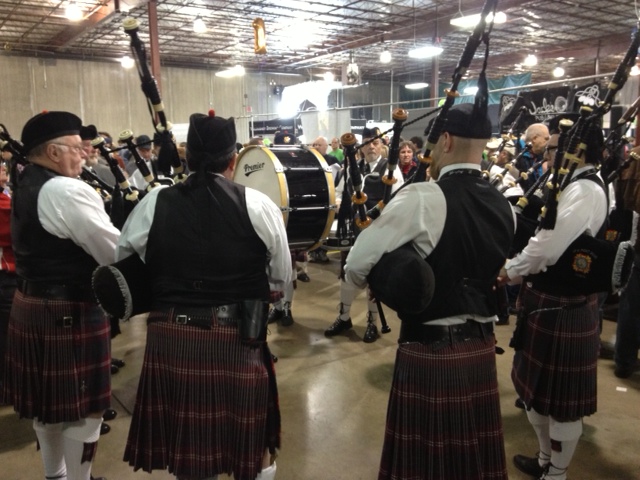
Clearly, the organizers of the Tap In have a wide view of what constitutes entertainment, which in my opinion only adds to the event’s appeal.
A writer could base a character on any member of the above groups.
What makes someone decide to become a roller derby girl? How good a skater do you really have to be? Does it take long to become proficient on the bagpipes? And do belly dancers actually feel more in touch with their womanly selves than the rest of us? For that matter, how can anyone really enjoy a hoppy beer?
Naturally, the biggest question is “Why?” Why does anyone hinge onto a particular hobby, form of recreation or occupation?
A writer burns to explore these questions, to learn the language if you will, of a variety of pastimes. We often find ourselves thinking, “You know, I could use someone like her in my book.” The result is often a total immersion into an alternate life as we create someone new with some of these characteristics.
There’s a quote by Catherine Drinker Bowen that sums this up nicely. She said, “Writing, I think, is not apart from living. Writing is a kind of double living.”
I think that’s one of the appeals of both reading and writing. They give us the opportunity to go outside ourselves, to live a different life without leaving our own.

World Book Night (Photo credit: danbruell)A Rave About Reading
It’s surprisingly difficult to find people who don’t like to read. Or maybe it’s just difficult to find those who will admit to it. Since the purpose of World Book Night is to reach “light and non-readers,” this presents a problem.
For those of you unfamiliar with the event, World Book Night is “a celebration of books and reading held on April 23, when 25,000 passionate volunteers across America give a total of half a million books within their communities to those who don’t regularly read. In 2012, World Book Night was celebrated in the U.S., the UK, Ireland, and Germany and saw over 80,000 people gift more than 2.5 million books.” (From World Book Night’s website http://www.us.worldbooknight.org/about-us/what-we-do.)
Last year, I arranged to hand out books at Starbucks before learning the book I would be giving out was mid-grade fiction, not ideal fodder for the coffee shop crowd. Plus, when I arrived, someone else had already set up shop (someone who, it turns out, did not ask permission, which made the manager less than happy when she found out).
My response was to go on the road. I wandered through our local grocery stores accosting every person I saw with a child. (Way to make parents nervous, Kym!) But grocery stores are surprisingly dead on Tuesday nights, and you can only roam their aisles for so long without being approached by management. I ran out of kids before I ran out of books.
In desperation, I turned into The Winking Lizard (a local bar and restaurant), an inspired choice as it turned out. The restaurant had pizzas on special for half-price. Every family in town seemed to be there (though the parents were no more sanguine at having a stranger trying to give books to their kids). Still, there were a lot of kids, and I managed to give away the rest of my books.This year, I requested only adult titles and having heard about my friend Holly’s success at Lagerheads Microbrewery, decided to hand them out at Great Lakes Brewing Company. Beer and books, what could be better?

English: A bottle of Dortmunder Gold pale lager beer, produced by Great Lakes Brewing Company of Cleveland, Ohio, United States. Photo taken at Lake Roaming Rock, near Roaming Shores, Ohio, United States (about 30 minutes east of Cleveland, in Ashtabula County) with a Nikon D40 digital camera. (Photo credit: Wikipedia)
After getting the go-ahead from Dan Conway (one of two brothers who own the brewery), I was ready. Since my book this year was Language of Flowers, I made up signs that said, “Do you know what your favorite flower means?” and “Hops symbolize injustice” (who knew?), and — more to the point — “Free books!”

08.24.12 (Photo credit: colemama)
Strangely, the only person who approached me was Rock, the chef, who offered to take a book for his girlfriend who is a “big reader.”
Several hostesses then asked for copies , as did the bankers who were having a drink with Dan and Pat Conway (“for their wives,” yeah sure, guys). Eventually, however, I began approaching customers.
“Are you a big reader?” I asked them.
Almost everyone answered yes, although two did ask rather suspiciously if the book was religious.I gave them books anyway. What else could I do? Say, “Oh, sorry. Then, I can’t give you this book.”? Hardly. I compromised by asking them to pass it on to someone who didn’t usually read.
Of all the people I approached, only three admitted to being light or non-readers. After enthusing about the story (secretly gloating that I’d found a non-reader), I pressed a copy of the novel into each of their hands.
I hope they read them.
P.S. The idea of World Book Night did spark some interesting conversations about reading. Or maybe that was the beer. I even gave away my personal copy of the Language of Flowers to one of the waitresses because several people said, “Oh, if you want to give a book away, you should give it to Fer.” (Fer, it turns out, is short for Jennifer, and she was delighted, having read previously read a positive review about Diffenbaugh’s book.)
P.P.S.S. Next year, I’m going to request only “guy” books and going back to Great Lakes.
Rave: Cancer Lessons Update and Shameless Library Promotion
First, the Cancer Lessons update: In the next few weeks, my Cancer Lesson posts will be disappearing from this blog and reappearing in a more cohesive format on a new one, Keeping A-Breast: Cancer Lessons (which you can read and follow here: http://kabcancerlessons.wordpress.com). The ultimate goal of this endeavor is a memoir, Keeping A-Breast: Lessons Learned While Fighting Cancer, about all the weird things you learn when you’re diagnosed with cancer. Look for more news as I progress on this project.
I’ve also established myself on Twitter as @KymLucas1 and @KeepingABreast2. I hope you will consider following me.
Now, for the shameless library promotion. My author panel is on Saturday, June 8 at the Buckeye Library in Medina County, Ohio. This year’s panel will feature Julie Drew, Amanda Flower, Jen Stephens and Mary Campisi. See below for a description of the event and a link to the registration page. If you live in northeastern Ohio and enjoy reading or writing, it would be great to see you there.
With the advent of digital and self-publishing, authors now have more avenues than ever for getting their books in print. Join authors Julie Drew (Daughter of Providence), Amanda Flower (Plain Scandal), Jen Stephens (The Heart’s Journey Home), and Mary Campisi (Simple Riches) as they discuss their own paths to publication, as well as the side trips they took along the way. Bring your questions, and come prepared to learn! Free and open to the public, but please register!
Location: Buckeye Library, 6625 Wolff Road, Medina OH
Time: 10:30 am-Noon
Registration: 330-725-4415 or http://tinyurl.com/c8tkv6d
For more information on the authors, please visit their websites.
 Julie Drew: www.juliedrew.com
 Amanda Flower: http://amandaflower.com/
 Jen Stephens: http://jenstephens.net/
 Mary Campisi: www.marycampisi.com
Rave: Words Are All I Have
From “Yahoo Answers”:
Resolved Question: What do you call a person who collects words?
Best Answer: A verbal archivist. Or a fruitcake.
Other suggested answers:
Lexicographer
Word magnet
“… a ‘Tracfone Service Person.’ They collect every word in the book. If you ever had to call one, you know exactly what I mean.”
Abecedarian
Word collector
Logophile
Wordcoholic
Most writers (and many readers) fall into these categories, I think, and I freely admit to being all of the above — except Tracfone Service Person. How else could I explain notes like the “overmorrow, polyemma, tittup” written in the margins of my manuscript?
I love “Word of the Day” emails and calendars, and have a bookcase full of volumes like Dewdroppers, Waldos, and Slackers: A Decade by Decade Guide to the Vanishing Vocabulary of the Twentieth Century and Why You Say It: The Fascinating Stories Behind Over 600 Everyday Words and Phrases.

Cover of Why You Say It
And, of course, I also have the Descriptionary: A Thematic Dictionary, and Flip Dictionary: For When You Know What You Want to Say But Can’t Think of the Word .

Cover of Flip Dictionary
Thesauruses are my friends, and a new book like Let’s Bring Back: The Lost Language Edition makes my day.
There’s no denying it; I’m a little weird about words.
But, honestly, what’s not to love about “A Collection of Forgotten-Yet-Delightful Words, Phrases, Praises, Insults, Idioms, and Literary Flourishes from Eras Past”?
Full of expressions like loblolly (“a seventeenth century oaf or lout” — even the definition uses words I love!), glump (“to sulk”) and keep your pecker up (not nearly as dirty as it sounds, the phrase simply means “stay cheerful”).
Some words are just fun to use. Groovy, floozy, strumpet and jiggery-pokery come to mind. And let’s not forget fiddle-faddle, malarkey and poppycock.
Others, like the aforementioned polyemma, mean exactly what they should. Worse than a dilemma where one has two choices, both of them bad, a polyemma involves multiple options, all of them undesirable.
There are also words like impeccable– prefix im- attached to peccable — but no one uses peccable (liable to sin or error) anymore, we only use its opposite.
I like those kinds of words too.
I read somewhere that the French are very protective of their language, trying to keep out words that stem from other cultures and countries.
How crazy is that? English is fun to write because our words spring from a variety of places. Our language is much the richer with words like hooligan (Irish), garage (French), and bamboozle (Scottish).
So, call me a verbal archivist or call me a fruitcake, I intend to enjoy playing with our language for a long, long time.
What about you? What are some of your resources for great words? Or maybe you could share some of your favorite words and expressions.
Rave: Periods of Dormancy
I found another rose-bush in our yard today, the second such discovery I’ve made in the last two years.

Before you jump to any conclusions about me and my husband’s fitness as land owners, I should tell you that we live on just under one and a half wooded acres that we refer to as the “nature conservancy.” Not quite the same as the city lot of our previous houses where we couldn’t miss even a new dandelion.
Also, we regularly turn up treasures left behind by the previous owners — random items like toilets, bed frames, car parts, toys, bottles and cans, to name just a few. Today, along with the rose, we discovered the metal springs from a bed (in a different place from where we found the frame), as well as several yards of rusty chicken wire and barbed wire fence.
Still, for someone who fancies herself a gardener, finding one rose was a bit of a shock. Finding two seems to be setting a pattern.
The weird thing is, both bushes were in parts of the yard we use on a regular basis, so it’s not like I wouldn’t have noticed them if they’d been there before.
No, both have been laying dormant for who knows how many years before re-emerging.
Last year, I couldn’t wait to see what kind of rose I’d found (a wild one, as it turned out). This year, I wondered what had changed to make them reappear.
But I also thought about people and their talents, which can be as dormant as my roses until something stirs that gift back to life.
With me, it was — and I hate to admit it — menopause. After waking up one too many times with hot flashes, characters began popping into my head with a story to tell.
Finally, I gave in and started writing again, after many years spent enjoying fiction solely as a reader.
How about you? Have you ever discovered or re-discovered an interest or talent that was previously dormant? If so, perhaps you’d like to leave a comment telling us about it.

#4054 wild rose (カニナバラ) (Photo credit: Nemo’s great uncle)
I hope my new rose looks like this!
Rave: A little post to keep you entertained
For some reason, hearing Thin Lizzy’s “The Boys Are Back in Town” always makes me feel like it’s finally spring.
Also John Fogerty’s “Center Field” though I’m not much of a baseball fan.
What song does it for you?

Cover of the 1982 album Vacation. (Photo credit: Wikipedia)
Rave: We have house guests for the next few weeks, so I will be taking a little vacation from posting, which means my faithful readers get a little vacation from me. 🙂


 Reading, Writing, Ranting and Raving